Fragmented markets consolidate, and the premium standard is set by whoever arrives first and sets it well. In this region the window is open now.
Opportunities of the kind that reward first movers are usually brief, and they are usually obvious only in hindsight. The premium education market of Central, Southern and Eastern Europe is, we believe, one such opportunity, and it is open now.
Begin with the structure of the market. European schooling remains remarkably fragmented, with the great majority of schools still independently owned rather than gathered into groups. In the region we focus on, that fragmentation is more pronounced still. Where North America and parts of Western Europe have already seen consolidation gather pace, the CSE European market is largely untouched, a market of fine individual schools operating alone, without the scale, the capital, or the professional governance that a group can provide. For a builder of school groups this is close to ideal ground.
Demand tells a complementary story. Across much of the region, public spending on education has been drifting downward as a share of national income, and it already sits below the European average both per head and in the aggregate. A shortfall of that kind does not vanish. It surfaces as a vacuum of demand for high-quality alternatives, felt most acutely by exactly the aspirational families who are willing to pay for something better. Our own analysis of the region’s cities points repeatedly to a chronic undersupply of premium places relative to the number of families able to afford them.
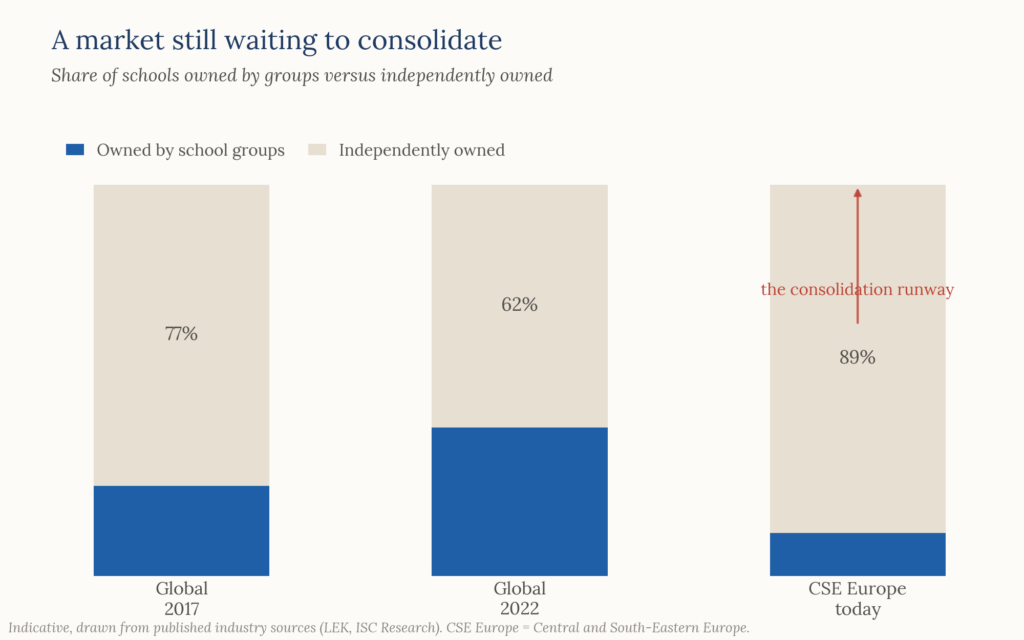
The share of schools still independently owned points to the runway ahead.
Then there is affordability, which is moving quickly in our favour. Real wages in the region have been growing at a pace well above the European norm, in some countries strikingly so. Populations may be stabilising or gently declining, but people are becoming richer faster than they are becoming fewer, and it is the balance of the two that governs the size of the market. A modest improvement in the affordability of private tuition, set against a slightly smaller cohort of children, still enlarges the addressable market substantially. The arithmetic favours the patient investor.
The wider context adds to the case. Deeper European integration, substantial planned investment in infrastructure, and growth in tourism and allied sectors all point toward a region on an improving trajectory over the coming years. Where capital and confidence flow, demand for quality education tends to follow.
The window will not stay open indefinitely. Fragmented markets are precisely the markets that consolidate, and the premium standard in any given city is set by whoever arrives first and sets it well. The advantage belongs to the group that establishes reputation, quality, and scale before the field grows crowded. That is the task edeq has set itself, and the reason we regard the coming few years as decisive rather than merely favourable. The region is ready. The work is to meet it in time.
Leave a Reply