Why one of the most important activities in human life still sits at the margins of the investment conversation, and what it costs us.
For an activity so central to human life, education occupies a curiously marginal place in the language of investment. We speak fluently of equities and bonds, of real estate and commodities, and, when we reach the frontier, of private equity and hedge funds. Education, if it appears at all, is folded quietly into whichever strategic wrapper happens to hold it. This is more than a matter of vocabulary. The way an asset is classified shapes the way it is understood, priced, and ultimately funded.
There is a subtle asymmetry between the public and private markets that deserves attention. In public markets we instinctively decompose the world by sector, on the sensible assumption that firms within an industry share common risks and common driving forces. In private markets that instinct is inverted. Assets are sorted first by strategy, buyout, growth, venture, and only loosely, if ever, by the industry in which they operate. The consequence is that a great deal of what makes an industry distinctive, its demographic tailwinds, its regulatory character, its pricing power, is absorbed into a strategic average and lost from view.
For most industries this may be a harmless simplification. For education it is not. When an entire sector is visible only through the lens of the buyout strategy that happens to own it, the sector’s own economic signature, its beta if you like, becomes almost impossible to observe. And what cannot be observed tends to go both unpriced and underfunded.
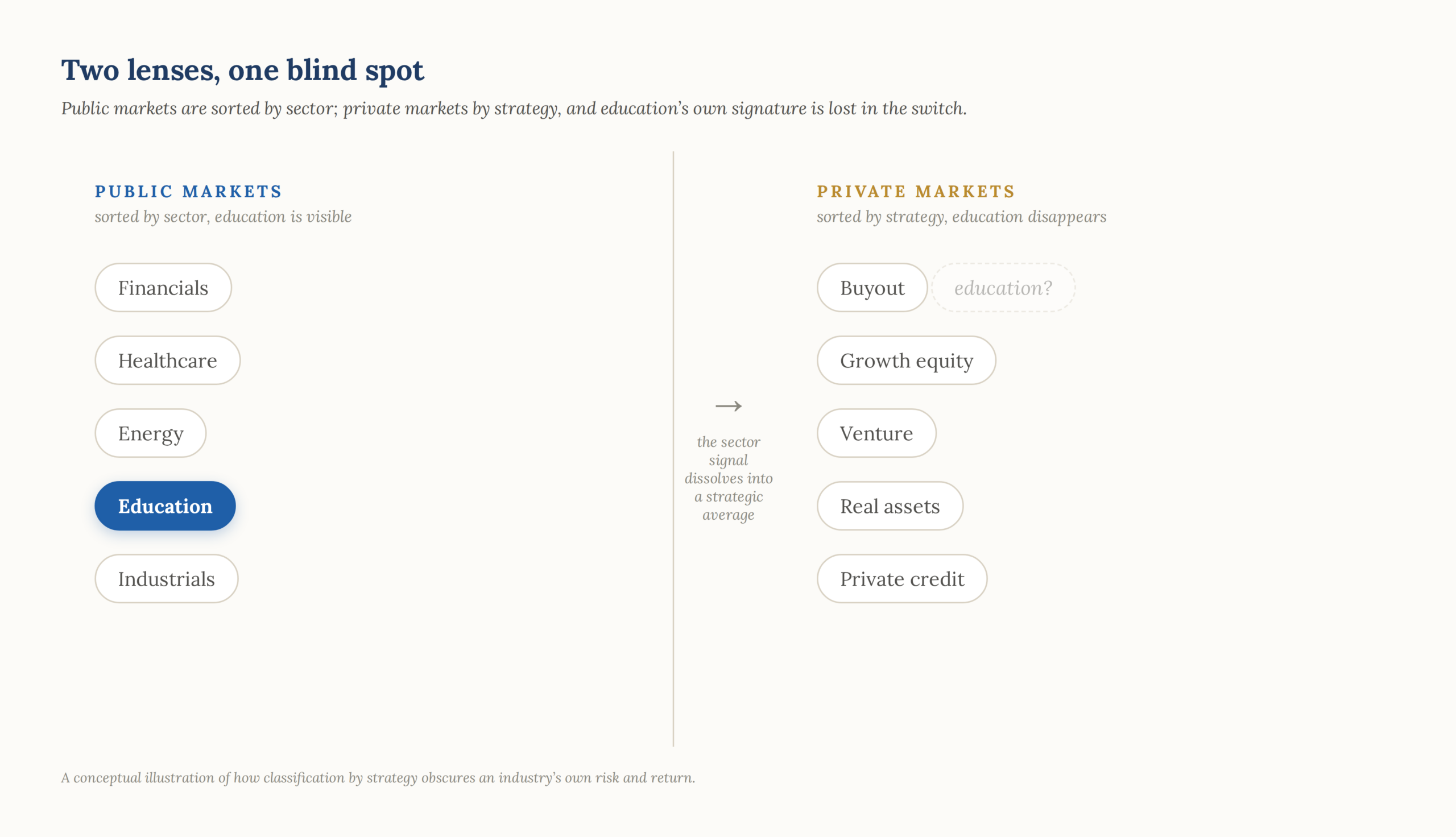
How classification by strategy hides an industry’s own risk and return.
Our founder’s recent research set out to correct this. By constructing an index that tracks the enterprise value of the leading private K-12 school groups over nearly two decades, it becomes possible to ask a question that had previously resisted a clear answer. What are the returns to owning private K-12 education, and how do they compare with the alternatives an allocator might reasonably hold instead? The answer, developed with due regard for the limitations of sparse private data, is striking enough to warrant the effort. Private K-12 education has delivered consistent, high returns across the period, with a risk profile more defensive than one might expect of an asset compounding at such a pace.
The deeper point is conceptual. Education satisfies the criteria that scholars have proposed for a distinct asset class. It is investable, it is difficult to replicate through other holdings, and it carries a risk and return profile of its own. That it has not been treated as such owes less to its economics than to the habits of classification we have inherited.
At edeq we take this seriously, because it describes precisely the gap we exist to close. Recognising education as an asset class in its own right is the first step toward allocating to it deliberately, rather than by accident of strategy. The schools are real, the demand is durable, and the returns, once brought into focus, speak for themselves.
Leave a Reply