A wider return
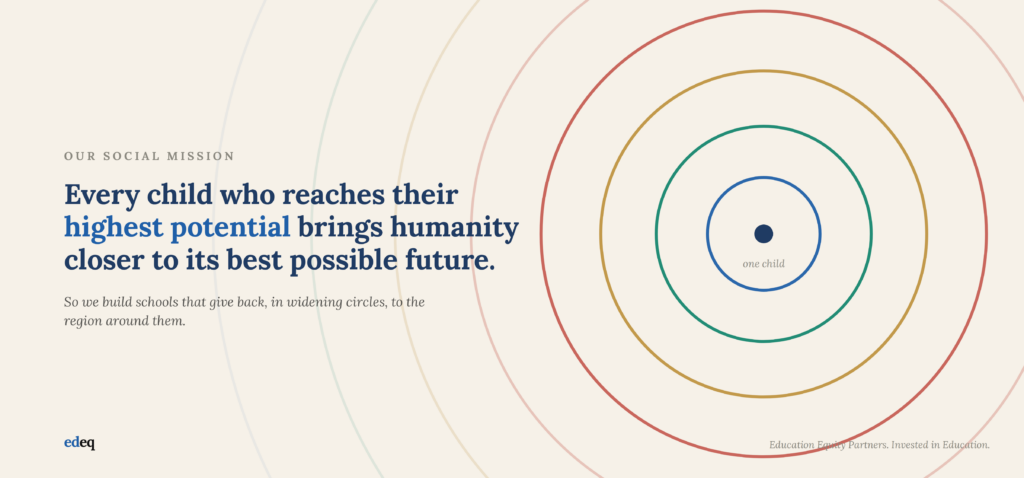
We believe a premium school should strengthen the place it stands in. edeq builds schools that widen the circle of benefit, from the classroom to the education system, the local and national economy, and the society around them.
An honest starting point
Premium education is, by its nature, selective, and we understand why some regard private provision with unease. Our view is straightforward. A healthy education system, much like a healthy system of healthcare, depends on public and private provision working together rather than on one replacing the other. Neither reaches its full potential alone. The state lays the foundation and guarantees access; independent and international schools add capacity, lift standards, and give families a genuine choice. The more useful question is how private education can be built to give back, and that is the question edeq sets out to answer.
Two distinct roles
It helps to distinguish between private education within a national system and international education, which follows a global curriculum and serves a different part of the population. International schools educate the children of mobile professionals, returning diaspora, and inward investors, and in doing so they perform a quiet economic function. A country able to offer world-class international schooling is far better placed to attract and keep the talent and capital its growth depends upon. Seen this way, an international school is a piece of economic infrastructure, and part of what sustains a nation’s balance of payments.
Widening circles of benefit
A single school, run well, sends benefit outward in widening circles. The image below is how we picture it, with the school at the centre and its contribution reaching progressively further into the region around it.
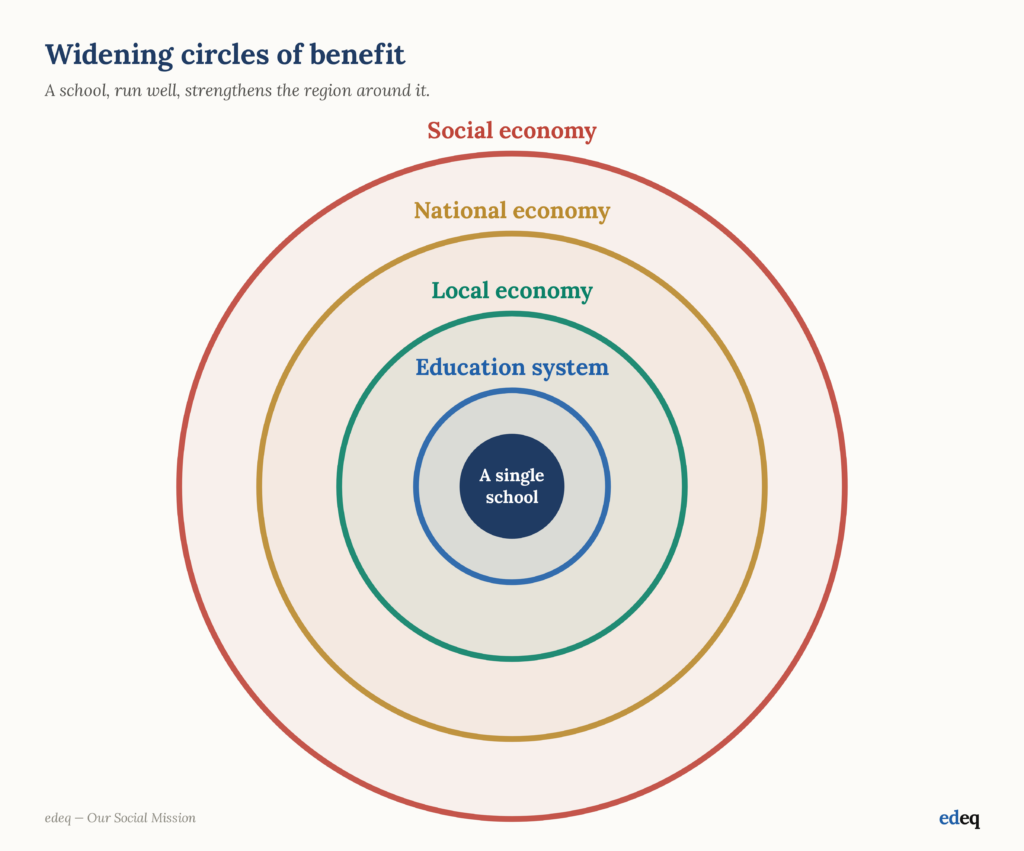
A single school strengthens ever-widening circles: the education system, the local and national economy, and the society around it.
The innermost circle is the single school, inside which we provide a point of community and belonging for families and a place of learning for every child. We believe fundamentally that every child who reaches their highest potential brings humanity closer to its best possible future. Outward of this is the education system. A serious independent school raises the standard of those around it, sharing what works and giving local families a real choice they did not have before. The next circle is the local economy, which a good school supports as an employer, as a customer of local services, and as a draw for the education tourism that follows international families. Wider still is the national economy, which depends on a country’s ability to attract and retain talent and investment, something world-class schooling helps to secure. The outermost circle is the social economy, the shared inheritance of capable, confident young people who go on to contribute to the life of their communities. Rather than separate projects, these circles are the natural consequence of running one school well, in one place, over many years.
What each circle means in practice
Principles matter only if they translate into action. Ours take concrete form at every level, from the classroom to the country.
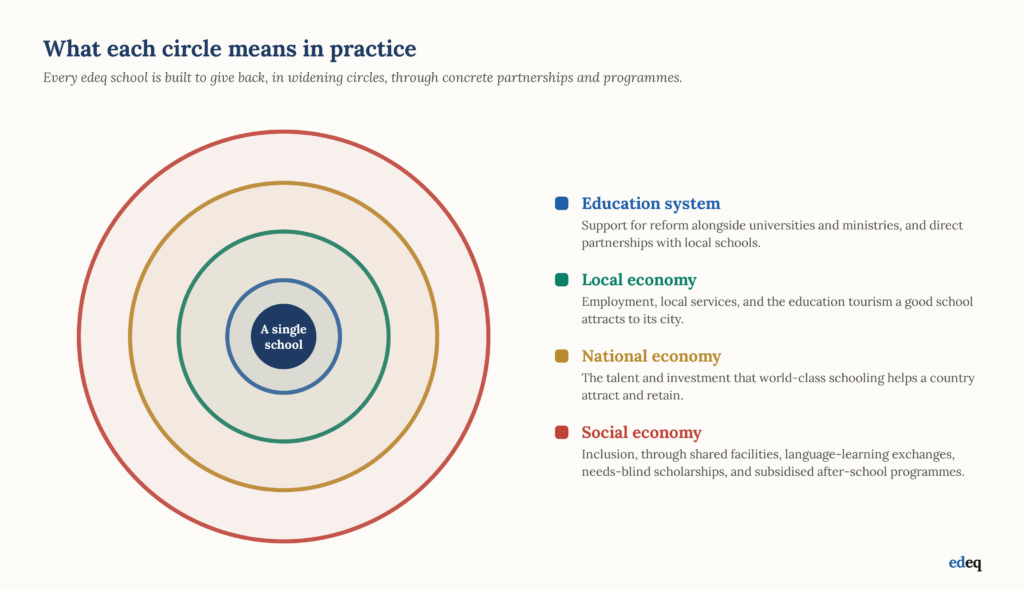
At the level of the education system, we support reform alongside universities and ministries of education, lending weight to their agendas for modernisation and helping to close the gap, often estimated at two decades, between educational research and everyday classroom practice. Alongside this system-level work we form direct partnerships with local schools.
At the level of the local economy, our schools contribute as they grow, through the jobs they create, the local suppliers and services they use, and the education tourism a respected international school attracts to its city. A growing body of research documents these effects.
At the level of the national economy, our schools help a country compete. World-class education is part of what persuades skilled people to come and to stay, and part of what reassures the investors whose capital a growing economy needs.
At the level of the social economy, our commitment is to inclusion. We open our schools to the wider community through shared facilities and language-learning exchanges, we run subsidised after-school programmes, and we admit deserving local students on a needs-blind basis so that ability, rather than means, decides who benefits..
A shared endeavour
We set this out plainly because it is central to how edeq creates value. The schools that give most to their communities are also those that earn the deepest loyalty, the strongest reputations, and the most durable returns. For partners who want their capital to build something lasting, the social mission and the investment case are one and the same.
Leave a Reply