The headline finding from our Founder’s recent paper, ‘Education as an Alternative Asset Class: The Case for Private K-12 Education’, pointed to a significant sector-specific alpha as compared with an index of global buyout funds. This gives us a view (and quite an extraordinary one) on the sector over the past 20 years, but what does it mean for the future?
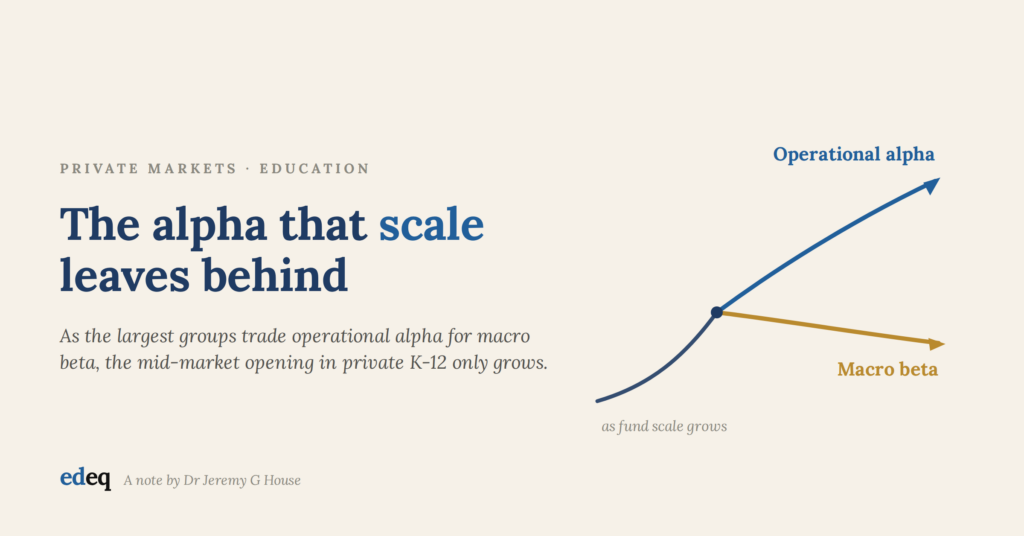
PitchBook’s recent article ‘Diminishing Returns to Scale – Redefining PE as a stratified asset class’ (Taylor Criswell, CFA) provides an interesting lens as they track the performance of ‘marquee’ funds and the changing nature of their profile as they scale their AUM. The implication is that as the fund size swells, the nature of their activities changes and they find it more difficult to replicate the over-performance that led to their original success. Ironically, this is a function of their success. As the nature of the deals they target changes and competition for these stiffens, they create less value on the operation side and more from ‘making big macro bets and using scale to drive revenue’.
Returning to private K-12 education, Dr House’s research is confirmation that this sector is indeed a strong and enduring ‘macro bet’. The larger school groups earned this via operational alpha but now risk trading that for macro beta. To our way of thinking, operational value creation remains at the heart of sustainable school improvement as both a financial and moral imperative. Thus, whilst the scaled education platforms, (possibly) thinking IPO in the not too distant future, are a solid macro bet, combining strong macros with proven operations-led value creation will provide the mid-market returns the mega groups simply cannot match in the K-12 eduction space; and do so without a billion dollar ticket.
Leave a Reply