Assets that promise growth and safety at once deserve suspicion first and interest second. Premium K-12 education survives the scrutiny.
Investors are accustomed to a trade. Higher returns are supposed to arrive with higher volatility, and safety is supposed to cost something in growth. Assets that appear to offer both at once deserve to be treated with suspicion, and then, if they survive the scrutiny, with interest. Private K-12 education is one of the few that survives.
Consider first the growth. The sector sits atop tailwinds that are unusually durable. A rising global middle class, greater international mobility, upward social aspiration, and a steady erosion of confidence in state education together sustain demand for quality schooling that shows little sign of fading. Fees have tended to rise a little ahead of inflation, year after year, and enrolments behave less like discretionary purchases than like multi-year commitments. A family that enrols a child rarely moves them, which lends the revenue a subscription-like quality that most industries would envy.
Consider next the risk. One might expect an asset compounding in the high teens to swing violently, and yet the evidence points the other way. Our founder’s research, having gone to some length to estimate a volatility for an asset whose valuations surface only at rare intervals, finds a profile that is meaningfully defensive, with a beta below that of the broad market and a downside shallower than its upside. In plain terms, the sector participates handsomely when times are good and gives back comparatively little when they are not. Price, it is worth remembering, ranks only sixth among the factors parents weigh when choosing a school, which tells you something about how resilient fee income is likely to be when budgets tighten.
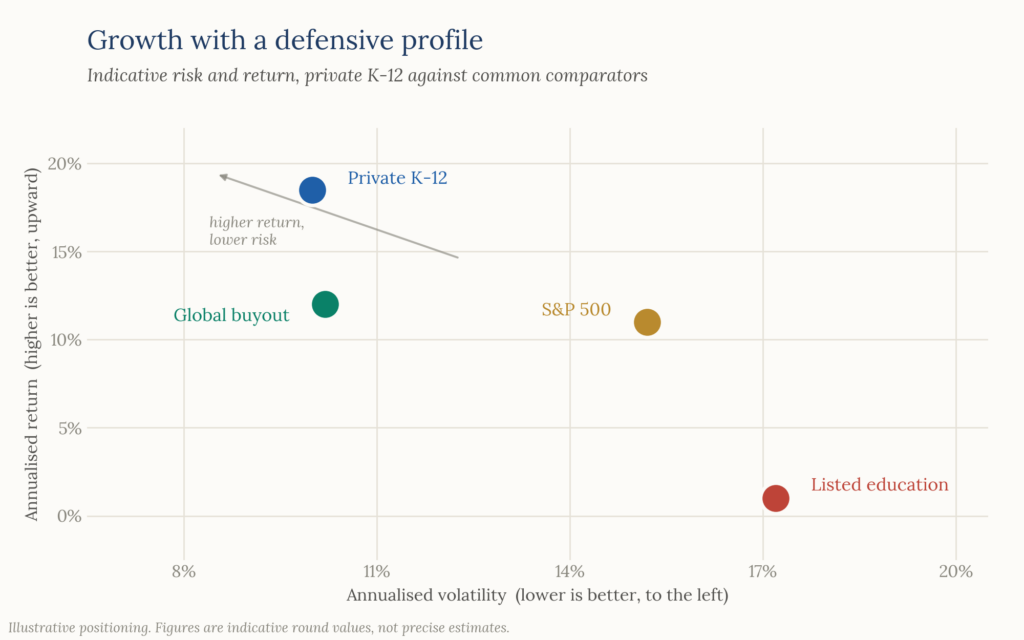
Indicative risk and return: private K-12 against common comparators.
The operating model reinforces the point. Schools are not capital-hungry in the manner of heavy industry, and they collect fees in advance of delivering the year’s teaching, which produces a favourable working-capital dynamic. Cash tends to arrive before it is needed rather than after. For an owner with a long horizon this is a comfortable place to stand.
None of this is to suggest the sector is without risk. Reputation is fragile in a business entrusted with children, regulation varies from country to country, and a poorly chosen site or an ill-judged acquisition can disappoint. These are real hazards, and they are precisely the hazards that reward discipline in selection and seriousness in governance. They are manageable, and managing them well is a large part of what an operator is for.
What remains, once the analysis is done, is the rare pairing an allocator is always hunting for: an asset that grows like an equity and steadies a portfolio like something far more conservative. It is this combination, durable demand met with a defensive profile, that makes premium K-12 education such an attractive foundation on which to build. At edeq it is the foundation on which we are building.
Leave a Reply