Two markets that ought to be close cousins have drifted so far apart that they now behave like different asset classes altogether.
One of the more disquieting findings to emerge from our founder’s research is the sheer distance between two things that ought, on the face of it, to be close cousins. Over an eighteen-year window an index of the leading private K-12 school groups and a broad basket of publicly traded education stocks diverged so completely that they came to occupy separate and almost unrecognisable universes. The private index compounded at a pace that turned an initial stake into a multiple many times over. The listed education names, taken together, barely moved, returning less than one per cent a year across more than a decade.
The instinctive response is to assume the comparison must be unfair, and it is worth taking that objection seriously. Private companies carry more leverage than their listed peers, and part of any private premium is compensation for illiquidity rather than genuine outperformance. These caveats are real and we do not wave them away. Even after allowing for them, however, the gap is far too large to explain by financing and liquidity alone. Something structural is at work.
Several factors suggest themselves. The listed education names are, in the main, smaller companies confined to local exchanges, with operations tethered to a single national market and its particular fortunes. A number are not pure education businesses at all, but conglomerates in which schooling sits alongside unrelated activities, so that the sector’s own performance is diluted rather than expressed. Some abandoned education during the period, and others were delisted altogether. Geographic reach and genuine focus, it turns out, matter a great deal.
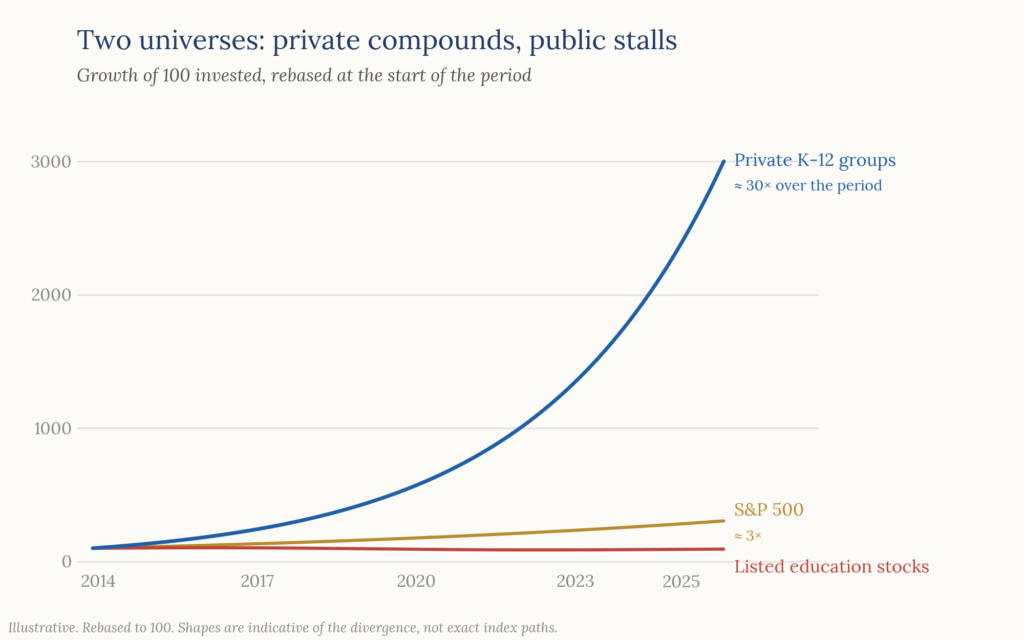
Illustrative growth of 100 invested, rebased at the start of the period.
The private groups tell the opposite story. They are global in operation, deliberately selective in where they build and buy, and concentrated wholly on the business of running schools. Freed from the quarterly gaze of public markets, they can pursue the patient, multi-year work of raising a school’s quality and reputation, and then its fees, without interruption. Scale brings its own advantages, from purchasing power to the ability to spread expertise across a portfolio. The result is a compounding machine that the public proxies simply do not capture.
There is also a quieter explanation, and it concerns information. Education has not yet been recognised by the broad investing public as a category worth understanding on its own terms. That inattention thins trading volumes in the listed names and restrains the flow of growth capital to the sector, which in turn holds back the very companies an investor might hope would prosper. The private market, where sophisticated buyers already compete keenly for the best assets, suffers no such neglect.
For an allocator the lesson is uncomfortable but clarifying. Exposure to education through listed proxies has been a poor way to own the theme. The returns have lived, almost entirely, on the private side of the divide. Closing that gap, by building and owning quality schools directly, is the work to which edeq is devoted.
Leave a Reply